LM-79 이동 감지기 Goniophotometer(거울 유형 C)
LSG-6000
고정밀 회전 조명기구 Goniophotometer
LSG-1890B
고정밀 회전 조명기구 Goniospectroradiometer
LSG-1890BCCD

자동차 및 신호 램프 용 고니 오 포토 미터
LSG-1950
신호등용 광도계 (경제형 모델)
LSG-1950S
VAD 화재 경보 시각 경보 장치 고니오포토미터
LSG-1930
공항 조명용 고니오포토미터
LSG-1940
소형 고니 오 포토 미터
LSG-1200A
LED 고니오포토미터
LSG-1100
근거리 무빙 탐지기 Goniophotometer
LSG-1900B
조직을 선택하세요
표준을 찾아보려면
추상
With the continuous development of export and domestic certification businesses for solid-state lighting products, IES LM-79-19 serves as an important specification for photometric and electrical measurement of solid-state lighting products, and it has become a mandatory technical basis for R&D, factory inspection and third-party certification of LED products. The High Precision Spectroradiometer Integrating Sphere System is the core hardware to implement this standard, and the equipment performance directly determines the accuracy and repeatability of test data such as luminous flux, chromaticity coordinates, correlated color temperature, color rendering index and electrical parameters. Focusing on the LISUN LPCE-2 LED CCD Fast Photometric, Colorimetric & Electrical Comprehensive Test System, this paper describes the core indicators, supporting components and standard compliance capabilities to be considered when selecting a High Precision Spectroradiometer Integrating Sphere System that meets IES LM-79-19 requirements. It also introduces the applicable test objects and covered domestic and international standard systems of the system, providing reference for equipment selection in lighting enterprises’ quality control laboratories and third-party testing institutions.
The quality evaluation of LED lighting products cannot rely only on appearance and subjective visual perception. It requires objective evaluation through multi-dimensional quantitative photometric, colorimetric and electrical parameters. Indicators including luminous flux, luminous efficacy, chromaticity coordinates, correlated color temperature, color rendering index, input power and power factor jointly determine product performance grade, energy efficiency label and market access qualification. In addition to LED luminaires and LED modules, traditional light sources such as energy-saving lamps, fluorescent lamps, HID lamps (e.g. high-pressure sodium lamps and high-pressure mercury lamps) and cold cathode fluorescent lamps also need photometric and colorimetric testing. The High Precision Spectroradiometer Integrating Sphere System collects optical signals uniformly via an integrating sphere, and then completes spectral analysis by the spectroradiometer to obtain full spectral, photometric, colorimetric and electrical test data in one measurement. It is the mainstream test solution for laboratories in the lighting industry.
The IES LM-79-19 standard imposes strict constraints on test environment, equipment accuracy, test procedure and report output for solid-state lighting products. It is accompanied by related specifications such as LM-79-24 및 LM-80. Corresponding domestic standards include GB/T 24824, while international chromaticity specifications cover CIE177, CIE-13.3, CIE-84, North American ANSI-C78.377, European (EU) 2019/2015 energy efficiency regulations and other documents. If the High Precision Spectroradiometer Integrating Sphere System fails to satisfy the technical requirements of the above standards, problems such as drifting test results, excessive data deviation in inter-laboratory comparison, and failed third-party certification despite in-house qualified tests will occur, directly affecting product R&D iteration and export certification progress. LISUN LPCE-2 High Precision Spectroradiometer & Integrating Sphere System can test energy-saving lamps, fluorescent lamps, HID lamps (e.g. high-pressure sodium lamps and high-pressure mercury lamps), cold cathode fluorescent lamps and LED lamps. LED quality shall be verified by inspecting its photometric, colorimetric and electrical parameters. The test results of this system satisfy the photometric and colorimetric test requirements of CIE177, CIE-13.3, CIE-84, ANSI-C78.377, GB/T 24824, IESNA-LM-63-2, 광학 엔지니어링-49-3-033602, (EU) 2019/2015, LM-80, LM-79-19 LM-79-24, and can provide graded configuration schemes for laboratories of different scales.
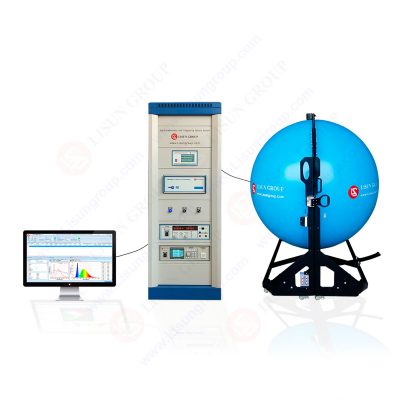
고정밀 분광 복사계 통합 구 시스템 LPCE 2(LMS 9000)
The IES LM-79-19 standard sets mandatory requirements for four major modules: integrating sphere, spectroradiometer, power supply unit and software functions. For the integrating sphere, the standard requires high diffuse reflection stability of the inner coating. A one-piece forming process is preferred to reduce light loss caused by splicing gaps. An auxiliary lamp device must be equipped for self-absorption correction to eliminate negative deviation of luminous flux results caused by light absorption of the sample itself. At the spectroradiometer level, lower limits are defined for wavelength accuracy, chromaticity coordinate accuracy, stray light level and photometric linearity. Excessive stray light will lead to chromaticity shift, while insufficient photometric linearity will expand measurement errors for samples with different brightness levels.
The power supply unit is also an indispensable part. The standard requires AC and DC power supplies to have high load regulation, and the output accuracy of voltage and current shall match the test conditions of LED samples to avoid light output drift caused by power supply fluctuation. On the software side, the system needs to collect complete spectral data and support exporting test reports in standard format containing full luminous flux, luminous efficacy, chromaticity parameters and electrical parameters. If extended LM-80 luminous flux maintenance test is required, the system should also support long-term time-series data recording. Some selection misunderstandings focus only on spectroradiometer parameters while ignoring integrating sphere craftsmanship, power supply accuracy and self-absorption correction function. The High Precision Spectroradiometer Integrating Sphere System works as a coordinated integrated unit, and high performance of a single component cannot guarantee the whole machine complies with LM-79-19 표준.
LISUN LPCE-2 series High Precision Spectroradiometer Integrating Sphere System is divided into LPCE-2(LMS-9000C) high-precision version and LPCE-2(LMS-9500C) scientific-grade version to adapt to different customer budgets and test stringency levels. Small and medium-sized enterprises and general testing institutions can select the LMS-9000C configuration. Large and medium-sized enterprises and third-party certification testing institutions with higher uncertainty requirements are recommended to adopt the LMS-9500C scientific-grade CCD spectroradiometer. Its detector uses Hamamatsu cooled back-illuminated CCD to reduce measurement errors brought by temperature drift. Both systems adopt one-piece integrating sphere with sample platform. Compared with traditional spliced integrating spheres, it reduces light leakage at seams, is equipped with auxiliary lamps for self-absorption coefficient correction, and supports temperature monitoring inside and outside the integrating sphere to adapt to temperature-related tests of LM-82.
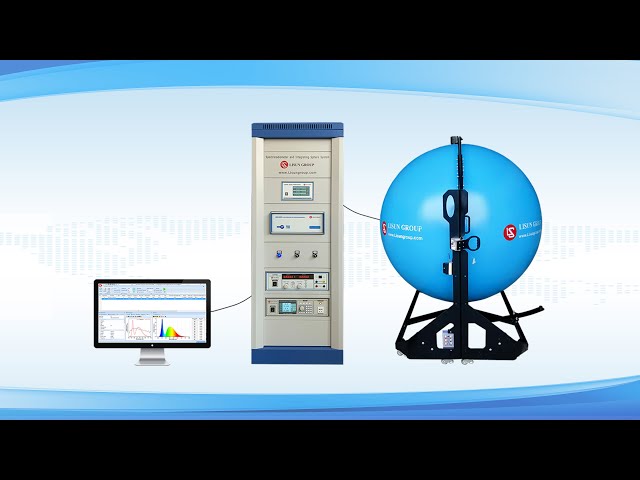
The complete system consists of spectroradiometer, optical fiber, digital power parameter meter, variable-frequency AC power supply, DC regulated power supply, integrating sphere, standard light source and standard cabinet. The software supports Chinese and English operation, compatible with Win7 to Win11 operating systems. The USB driver is Microsoft certified. It can directly output LM-79 photometric, colorimetric and electrical reports in PDF format, as well as LM-80 luminous flux maintenance reports in Excel and PDF formats. The table below compares key technical indicators of the two core spectral measurement units:
| 항목 | LMS-9000C (High Precision Version) | LMS-9500C (Scientific Grade Version) |
|---|---|---|
| Wavelength Measurement Accuracy | ± 0.3nm | ± 0.2nm |
| 파장 반복성 | ± 0.1nm | ± 0.1nm |
| Chromaticity Coordinate Accuracy (Standard Source A) | ± 0.002 | ± 0.0015 |
| Correlated Color Temperature Measurement Range | 1500천~100000만 | 1500천~100000만 |
| Correlated Color Temperature Accuracy | ± 0.3의 % | ± 0.2의 % |
| CRI Measurement Accuracy | ±(0.3%rd±0.3) | ±(0.3%rd±0.3) |
| Luminous Flux Measurement Range | 0.01‑200000lm | 0.01‑200000lm |
| 광도 선형성 | ± 0.5의 % | ± 0.2의 % |
| Stray Light (600nm) | ||
| 통합 시간 범위 | 0.1‑10000ms | 0.1ms‑60s |
Besides the hardware indicators of the spectroradiometer, the selection should be comprehensively evaluated combining the type of tested light sources, luminous flux range and future standard expansion requirements. The first is the integrating sphere size. LPCE-2 can be equipped with different specifications such as 0.3M and 1.5MA integrating spheres. IES LM-79-19 requires the inner diameter of the integrating sphere to be at least twice the maximum outer dimension of the sample. Larger luminaires need to be matched with larger-diameter integrating spheres; otherwise the self-absorption effect will increase and affect test results. The second is coverage of test parameters. Apart from conventional chromaticity coordinates, color temperature and CRI, more and more market demands require extended parameters such as TM-30-24 (Rf, Rg), CQS, PAR, PPF, WPE and EQE for plant lights. It is necessary to confirm that corresponding algorithms have been built into the system software. Third is power supply matching. LEDs are divided into AC-driven and DC-driven types. The equipment needs to be equipped with both AC variable-frequency power supply and DC regulated power supply. The stability of voltage and current output of the power supply directly affects the optical output stability of LEDs. Fourth is standard expansion. If enterprises intend to carry out LM-80 luminous flux maintenance test later, a constant-temperature integrating sphere and multi-channel temperature scanner can be selected to meet the complete test conditions of IES LM-82.
Software reporting function also cannot be ignored. For certification testing scenarios, complete reports complying with LM-79-19 specifications containing spectrogram and all photometric, colorimetric and electrical parameters need to be generated directly and support PDF export. For R&D scenarios, raw test data can be exported in batches for engineers’ statistical analysis. The traceable calibration capability of equipment should also be included in evaluation. The whole High Precision Spectroradiometer Integrating Sphere System can be matched with traceable standard light sources for regular equipment calibration, ensuring traceability of laboratory test data and meeting the requirements of laboratory system audit such as CNAS.
The High Precision Spectroradiometer Integrating Sphere System is widely applied in R&D laboratories, production line quality control of LED lighting manufacturers, third-party testing institutions and university research institutes. At the product R&D stage, engineers can quickly obtain complete spectral, luminous efficacy and chromaticity data with the system to compare performance differences among different light source schemes, driver schemes and phosphor schemes, shortening new product development cycles. In production quality control, incoming and finished product sampling inspections are implemented to screen defective products with color temperature drift, insufficient luminous efficacy and unqualified color rendering index. For export business, test data conforming to IES LM-79-19 serves as important input materials for certification projects such as ENERGY STAR in North America. Meanwhile, it is compatible with GB/T 24824, (EU)2019/2015 and other domestic and European standards, enabling one set of equipment to verify products for both domestic and overseas markets.
를 선택할 때 고정밀 분광 방 사계 통합 구 시스템 회의 IES LM-79-19 standard, it is insufficient to merely compare single spectroradiometer parameters. Comprehensive assessment should be carried out from multiple dimensions including spectroradiometer accuracy, integrating sphere structure and craftsmanship, auxiliary self-absorption correction device, performance of power supply unit, software algorithm and report output, and expandability. LISUN LPCE-2 LED CCD Fast Photometric, Colorimetric & Electrical Comprehensive Test System has two configurations: high-precision and scientific-grade. It fully covers energy-saving lamps, fluorescent lamps, HID lamps, cold cathode fluorescent lamps and LED light sources. Its test results meet many domestic and international photometric and colorimetric standards including CIE, ANSI, GB/T, IES LM-79-19, LM-79- 24, LM-80 and (EU)2019/2015, and can satisfy stringent test requirements of small and medium-sized enterprises for R&D and quality control as well as third-party certification institutions. A compliant and reliable High Precision Spectroradiometer Integrating Sphere System is the basic hardware for lighting product quality control, standardized testing and international trade certification. It helps enterprises avoid R&D rework, certification failure and product quality risks caused by non-compliant test equipment.
태그 :LPCE-2 (LMS-9000)귀하의 이메일 주소는 공개되지 않습니다. 필수 필드가 표시됩니다 *

 영어
 中文简体
 Русский
 Español
 Português
 Türkçe
 العربية
 Deutsch
 Polski
 Italiano
 Français
 한국어
 ไทย
 Tiếng Việt
 日本語